Free English classes on Koh Tao are run every week by Horizon Asia Educational Association (HAEA), an Austrian nonprofit, in partnership with Wonderland Jungle Hostel. Twelve children and young adults from local Thai and Myanmar migrant communities attend at no cost, taught by volunteers who don’t need a teaching qualification to lead a session.
This is the consolidated answer to what those classes actually involve, the students, the teaching method, the volunteers who run it, and how you can be one of them.
Horizon Asia teaches 12 children and young adults free English classes weekly on Koh Tao, Thailand, drawing from local Thai and Myanmar migrant communities. The program is volunteer-led and has run continuously since it launched for Myanmar children in February 2023. Verified 2026-07-21.
Horizon Asia Educational Association, verified 2026-07-21
Who attends
The 12 students who show up each week come from two groups: children and young adults from Koh Tao’s local community, and children from Myanmar migrant families living on the island. For many, English is a third language layered on top of Thai or Burmese, HAEA frames it as foundational to what comes next, whether that’s healthcare access, employment, or further education. First names only are used for any minor referenced in HAEA materials, per safeguarding practice.
The program has also grown outward from the original children’s classes. A related HAEA initiative runs early-morning English sessions, Tuesdays and Fridays, for Myanmar workers moving from construction into hospitality and tourism roles, taught by volunteers including Cherry Koe, herself a former HAEA student, and Rawane Abdaoui, a volunteer with an engineering background. The core weekly count of 12 refers to the children’s and young adults’ classes on Koh Tao; the workers’ program runs alongside it.
What a class looks like
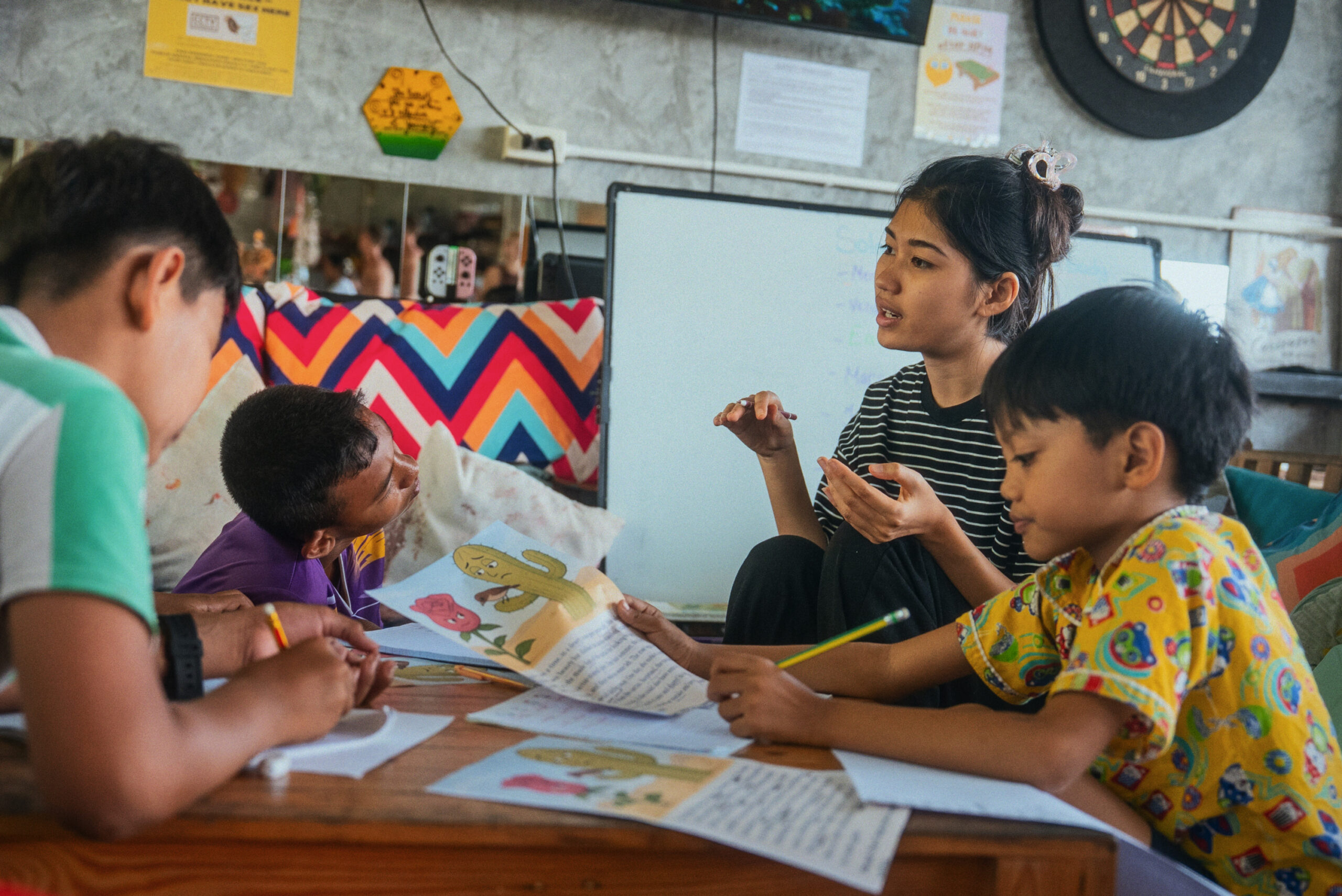
Classes happen in Wonderland Jungle Hostel’s communal space, no separate school building, no formal desks-in-rows setup. A typical session builds vocabulary through drawing: students sketch and then label what they’ve drawn in English, turning a new word into something personal rather than something memorized. HAEA’s own description of the method: “Every labelled word is progress. Every smile is confidence forming. Every class is one step toward fluency.”
Games, storytelling, and real-life role-play scenarios sit alongside the vocabulary work, moving students from basic grammar toward conversation and comprehension as they progress.
Why consistency is the point, not a bonus
HAEA’s own teaching philosophy treats a predictable weekly schedule as the foundation, not a nice-to-have. Consistency creates a safe space, students participate without fear of being wrong, because they know their teacher will be there the following week too. That matters more for some students than others: many attending are from Myanmar migrant communities where consistency, in general, has been harder to come by. The stated aim isn’t just vocabulary acquisition, it’s building confidence and a broader sense of what a student is capable of.
Who teaches
Nobody leading a class needs a formal teaching credential. More than 50 hostel guests volunteer as teachers each year, ranging from short-stay travelers to gap-year participants, and HAEA explicitly designs the program to run without requiring prior classroom experience.
A few volunteers have become the program’s most visible faces:
- Maroezka Williams, from a hospitality and tourism background, has led weekly English instruction for Thai and Myanmar students since at least mid-2024, teaching everything from basic grammar to advanced conversation.
- Rawane Abdaoui, an engineer by training, teaches ESL, science, and math, breaking down complex topics while keeping lessons personal, one student is on record describing her classes as helping her “believe I can achieve anything.”
- Cherry Koe, a former student who completed her own English studies through the program, now teaches younger Myanmar students herself, a case HAEA describes as a circle of impact: a student becoming the next community teacher.
That progression, student to volunteer teacher, is not an isolated story. It’s the model HAEA points to when explaining what “a good teacher” is meant to do: not just deliver information, but hand a student enough confidence and skill that they eventually stand at the front of the room themselves.
Beyond the weekly class
There is no formal gate between the weekly classes and a sponsored pathway. Students who keep showing up and want more are put forward for sponsorship, and HAEA covers the costs, finding motivated students, not funding them, is the hard part.
How you can help
Two ways to support the program, both of which HAEA treats as equally real forms of participation:
Volunteer. If you’re on Koh Tao, for a weekend or a season, you can lead or assist a class without prior teaching experience. Sign up at /volunteer/.
Give monthly. A recurring gift is HAEA’s primary ask because it funds classes on the same predictable schedule the teaching itself depends on. Start one on our donate page.
FAQ
How many students attend the free English classes on Koh Tao?
Twelve children and young adults attend weekly, drawn from local Thai and Myanmar migrant communities.
Do I need a teaching qualification to volunteer?
No. HAEA’s Koh Tao classes are designed to run with volunteers who have no prior teaching credentials, supported by more experienced teachers when available.
Where do the classes take place?
In the communal space at Wonderland Jungle Hostel on Koh Tao, which serves as HAEA’s operational base for the island’s programs.
Is there a cost to attend?
No. The classes are free for every student, funded by direct hostel bookings, volunteer time, and donor support rather than tuition.
Teach a class, or fund one
If you’re already headed to Koh Tao, bring a lesson plan: sign up to volunteer at /volunteer/. If you’re not, a monthly gift keeps the same 12 seats filled every week, start one at /donate/.